

Peru on Mana — A 22-Day Guarana-Fueled Andean Journey
Updated: 2026-06-26
Start here
New to Mana Rush? Start with the guide that fits your goal
If you are comparing coffee alternatives, natural energy powder, and smoother caffeine routines, these are the best next steps.
Mana Rush Guarana · Travel Journal · June 2026
Peru on Mana
22 days. 4,950 metres. One bottle of lemon powder.
22Days
4,950mPeak altitude
16Sites visited
7Cities
HNL → Houston → Bogotá → Lima → Cusco → Ollantaytambo → Aguas Calientes / Machu Picchu → Cusco → Puno / Titicaca → Colca Canyon → Arequipa → Lima → Cancún → HNL
Peru doesn't ease you in. You land, you climb, the altitude grabs you by the collar, and every day demands something more from your body than the last.
I packed light — clothes I could layer, a good pair of boots, and a bag of Mana Rush Guarana Lemon. Twenty-two days through the Andes taught me a lot about pace, about breathwork, and about how far a clean, steady energy can carry you.
⚡ MRG Lemon · The protocol
Every morning: 300ml of water + a scoop of MRG Lemon, sipped slowly through the first hour of the day. No crash. No jitters at altitude. Just enough mana to keep moving when the mountain said otherwise.
June 4 — HNL → Lima
Three flights, two continents, one very long day
Left Kāneʻohe before dawn. Honolulu to Houston, Houston to Bogotá, Bogotá to Lima — a full transit day threading through hemispheres. The kind of day where the hours blur and your body clock quietly gives up.
⚡ MRG Lemon · Transit fuel
A dry scoop stirred into a water bottle in the Houston terminal kept the fog at bay through the long Bogotá leg. The slow-release guarana curve meant I landed in Lima wide awake rather than wrecked — no spike, no crash, just a clear head for check-in.
June 5–6 — Lima
Sea-level breathing while the body adjusts
Two nights in Lima — the city runs on strong coffee and ceviche, and the ocean humidity is a welcome contrast to what's coming. I used the flat days to walk, eat well, and let sleep do its work before the ascent to Cusco. These were the last two mornings I'd wake up without thinking about oxygen.
June 7–10 — Cusco
The Imperial City at 3,400 metres
⛰ 3,400 m · Soroche territoryCusco hits you on the walk from the gate. The air is thin, the light is strange and brilliant, and everyone moves a little slower than they think they need to. Four nights here, working through the Boleto Turístico del Cusco — 16 archaeological and cultural sites across the region.
Museo Histórico Regional
Arte Contemporáneo
Arte Popular
Museo de Sitio Qorikancha
Centro Qosqo Arte Nativo
Monumento a Pachacuteq
Tipón
Pikillaqta
Chinchero
Moray
Tambomachay
Puca Pukara
Q'enqo

Maras salt pans — in use since Inca times
 |
 |
Cusco street life · Qorikancha (BTC site #4)

Moray — Inca agricultural laboratory (BTC site #10)
Each site is a different kind of walk. Moray's circular terraces drop you into an Incan agricultural laboratory. Tipón's water channels are still running after 600 years. The cumulative distance across four days is serious — stone paths, uneven steps, thin air throughout.
⚡ MRG Lemon · Daily altitude protocol
Every morning in Cusco: a small 300ml bottle of water mixed with MRG Lemon, sipped before and during the first hour of each day's site visit. At altitude, caffeine hits differently — the slow release of guarana was exactly what I needed. No pounding heart, no altitude-amplified jitters. Clean energy that matched the pace of walking on ancient stone.
🌿 Altitude & the Andes — Coca Leaves & Muña
Coca isn't white. Coca is green.
You can get coca leaves everywhere in Peru — tea, hard candy, fresh leaves handed to you at hotel check-in, loose bags sold at every market stall. It's as normal and unremarkable as a mint on your pillow. And it has nothing to do with cocaine beyond sharing a plant family. The alkaloid concentration in a whole coca leaf is a tiny fraction of a percent. What you actually get is a mild, functional lift and — far more useful at altitude — better oxygenation of the blood.
That's the mechanism behind coca as an altitude sickness remedy: the leaves help the blood enrich itself with more oxygen, directly countering the fatigue, headaches, and breathlessness that define the first days above 3,000 metres. It's been the Andean remedy for soroche (altitude sickness) for thousands of years. It works. Most hotels in Cusco offer coca tea on arrival — accept it.
As for the flavor — coca tea is earthy, herbal, and acquired. Not unpleasant, just not something you'd order for the taste.
The other plant worth knowing is muña — a small wild herb native to the Andean highlands that looks and smells like a mountain mint. It has similar altitude-supporting properties to coca and also aids digestion, which matters when you're eating heavy Andean food after days of hard walking. Unlike coca, muña tea actually tastes great — bright, clean, genuinely minty. I had it after most evening meals and found it far more enjoyable than coca.
One practical note: coca leaves cannot be taken out of Peru legally — they're a controlled substance at the border, including into the US and Hawaii. Muña, however, is unrestricted. I brought dried muña home to Kāneʻohe without issue. If you want a botanical souvenir from the Andes that you can actually keep, muña is the one to pack.
~June 9 — Palccoyo Rainbow Mountain
The rainbow mountain fewer people know about
⛰ 4,950 m · Highest point of the tripMost travelers go to Vinicunca. Palccoyo is the quieter version — less visited, shorter trail, and the same extraordinary striped geology painted across a high Andean ridge. At 4,950 metres this was the roof of the entire journey. The air at that elevation is about 55% of what you're used to at sea level. Every step is a negotiation.
⚡ MRG Lemon · Peak performance at 4,950m
Mixed a full 300ml the night before and kept it in my jacket pocket. At the summit, sipping slowly rather than gulping was everything — the cold, the altitude, and the physical effort all compound. The lemon cut through the cold air cleanly. I finished the bottle at the ridge. No headache. Good clarity. The kind of energy that feels earned.
June 11–14 — Ollantaytambo
The living Inca town in the Sacred Valley
⛰ 2,792 m · Sacred Valley floor |
 |
Ollantaytambo town · Temple terraces looking up

Made a friend at the terraces
The tour bus out of Cusco winds down into the Sacred Valley — and the drop in altitude is immediately felt in your lungs. Ollantaytambo is where the Incas stopped the Spanish advance, and walking its terraces you understand why. Four nights based here, with the Sun Temple as the centrepiece.
⚡ MRG Lemon · Temple climb fuel
The terraces at Ollantaytambo are steep — hundreds of steps up to the unfinished Sun Temple, set against a wall of Andean peaks. Pre-mixed MRG before the morning climb, drank it on the way up. The sustained energy matches that kind of long physical effort better than a quick coffee hit ever would.
June 15–16 — Aguas Calientes & Machu Picchu
The train, the fog, the citadel
⛰ 2,430 m · The lost city
Machu Picchu — the lost city at 2,430m
 |
 |
The locals have no concept of personal space
Train from Ollantaytambo to Aguas Calientes, then the bus up the switchbacks in the morning dark to arrive at the gate before the clouds lifted. Machu Picchu in the first light, before the crowds, is one of those moments that recalibrates your sense of what human ambition looks like.
Two nights in Aguas Calientes. The hot springs were a genuine luxury after a week of hard walking. The reviews online had flagged them as rough — dirty water, poor conditions. I went anyway. The water is naturally sulfuric and runs a little murky, which is just what geothermal spring water does. That's not grime, that's geology. Everything else was genuinely well kept — staff visibly busy taking care of the place. Not a five-star spa. But after ten days at altitude it delivered exactly what it needed to, and the reviews undersold it.
⚡ MRG Lemon · Pre-dawn citadel morning
Bus to the gate leaves at 5:30am. MRG mixed in the hotel room, carried up in a jacket pocket, sipped while waiting for the citadel to emerge from the morning cloud. The slow arc of guarana energy is built for exactly this — a long morning of walking and looking, where you want presence without the edge.
June 17–19 — Cusco (Return)
Collectivo back, three more nights in the Imperial City
Collectivo van from Aguas Calientes back to Cusco — the mountain road version of what a cab ride looks like in the Andes. Three more nights in Cusco, revisiting the city itself: the Cathedral, San Blas, the markets, the streets. By this point the body had adapted. Moving around Cusco at 3,400m felt almost normal.
June 20–21 — Puno & Lake Titicaca
The Titicaca train and the floating islands
⛰ 3,812 m · World's highest navigable lake
La Raya pass · 4,319m · Cusco–Puno crossing

Altiplano llamas — they're everywhere out here

Puno Cathedral · Plaza de Armas at golden hour

Uros floating reed islands · Lake Titicaca
 |
 |
Island excursion — traditional dance & island life
The Titicaca train from Cusco is a slow, spectacular ride across the altiplano — the high plateau connecting the two cities across some of the most open landscape on earth. Puno sits on the western shore of Titicaca, and the island excursion to the Uros floating reed islands is a morning well spent. The lake is immense. The light at that altitude, over water, is extraordinary.
⚡ MRG Lemon · Altiplano crossing
The train ride is hours of flat, high plateau. I mixed MRG in my water bottle before boarding and had it through the morning crossing. Watching the altiplano unfold — the llamas, the adobe farms, the impossibly blue sky — with clear, alert energy felt exactly right.
June 22 — Colca Canyon
From Chivay, condors at dawn
⛰ 3,635 m · One of the world's deepest canyons
Colca Canyon — one of the world's deepest

Cruz del Cóndor viewpoint · Colca Canyon

Chivay hot springs — earned after the canyon
One night based in Chivay, gateway to Colca Canyon — twice as deep as the Grand Canyon. The condor viewpoint (Cruz del Cóndor) is the centrepiece: the birds catch the morning thermals and rise from the canyon floor in wide, unhurried spirals.
Same story on the hot springs — the reviews had flagged the Chivay springs as not worth it. I ignored them and was glad I did. The water runs murky and warm and smells of sulfur; that's the nature of a geothermal spring, not a maintenance failure. The staff were on top of everything — stonework, changing rooms, the paths between pools all in solid condition. A hot spring cut into a canyon wall at altitude. The reviews undersold it.
⚡ MRG Lemon · Condor watch morning
Early morning, cold, standing at the canyon rim waiting for condors. There's a particular kind of patience that early-morning wildlife watching demands — alert but still. MRG is good for this. No fidgeting energy, just clean focus while the canyon slowly filled with light and the first shapes rose from the deep.
June 23–25 — Arequipa → Lima → Cancún → HNL
The White City, and the long way home
⛰ 2,335 m · The White City
Arequipa — the White City, Volcán Misti behind

Volcán Pichu Pichu 5,664m · Volcán Misti 5,825m
One night in Arequipa — built from white volcanic sillar stone with three volcanoes for a backdrop. Then Lima for the international connection, a stopover in Cancún, and finally home to HNL on the 25th. The Cancún days were natural decompression — warm, flat, sea-level. After three weeks in the Andes, lying on a beach felt almost surreal.
⚡ MRG Lemon · The long way home
Lima to Cancún to HNL is a full travel day. The same carry-on trick from the outbound flight: a scoop in a water bottle through the Lima terminal. Landed in Honolulu ready to unpack rather than collapse. Twenty-two days, 4,950 metres, and one bag of lemon powder that made it the whole way.
What they don't put in the brochure
Peru is not a comfortable trip.
Nobody tells you that most of the Andes runs on cold rooms and thin blankets. Every guesthouse I stayed in — Cusco, Puno, Chivay — had no heaters. You sleep in whatever you packed, layered up, and hope the altitude doesn't wake you at 2am with a headache.
The beds ranged from fine to genuinely questionable. By week two, my body was running a sleep deficit that no amount of good intentions was going to fully close.
🌡️ No heating. Anywhere. Every room — Cusco, Ollantaytambo, Aguas Calientes, Puno, Chivay — cold at night. You sleep in thermals and adapt, but it chips away at recovery. |
⏰ 4am starts, 10pm ends. Every activity required a 4am alarm. Machu Picchu bus, condor watch, early trains. Most nights didn't wrap until 10. That math doesn't work for long. |
🛏️ Sleep quality: variable. Some nights fine, others a thin mattress at altitude with traffic outside and a dog barking in the valley. You take what you get and keep moving. |
📅 Fixed window, no days off. 22 days, one chance. There's no rest day when the train only runs Tuesday and the permit is for Thursday. You made the commitment, so you honor it. |
By week three, I knew exactly what MRG was doing and what it wasn't. It wasn't fixing the sleep. Nothing was going to fix the sleep. What it was doing — every morning, mixed into 300ml of cold water — was bridging the gap between how I felt and what the day required.
By the end I'd lean on it too hard some days. Guarana isn't a substitute for sleep — it's a tool, and like any tool it works better when the rest of the foundation is solid. But in the context of a 22-day Andean push with a hard end date? It earned its place in the pack every single day.
"Guarana isn't sleep. But on the days when sleep wasn't on offer, it was the closest thing I had to showing up ready."
Energy that travels with you.
Peru isn't a destination you approach casually. The altitude is real, the distances are long, and every day you're asking something physical from a body that's still adjusting. What you put in matters.
Mana Rush Guarana Lemon went into a 300ml bottle every morning for three weeks. It mixed clean, tasted good at altitude, and delivered the kind of steady, unhurried energy that long days of walking, climbing, and wondering demand.
No crashes at Machu Picchu. No jitters on Palccoyo's ridge. Just mana — doing exactly what it should.
Mana Rush Guarana · Kāneʻohe, Hawaiʻi
Small-batch natural guarana energy powder.
Made for the days that ask the most of you.
Frequently asked questions
What is guarana?
Guarana (Paullinia cupana) is a climbing plant native to the Amazon basin whose seeds are one of the richest natural sources of caffeine. Used for centuries by Amazonian peoples for energy and focus, guarana delivers its caffeine more slowly than coffee due to natural plant compounds including tannins, saponins, theobromine, and theophylline.
Is guarana better than coffee for energy?
Many people find guarana energy smoother and more sustained than coffee because its caffeine releases gradually over 4–6 hours rather than hitting in a quick spike. The additional plant compounds in guarana — theobromine, tannins, polyphenols — modulate how caffeine is absorbed, producing a steadier lift with less of the heavy crash.
How long does guarana stay in your system?
Caffeine from guarana has a half-life of about 4–6 hours in most adults, with the slow-release profile meaning effects build gradually and taper off more gently than coffee. Metabolism, body weight, and caffeine sensitivity affect individual duration.
What is natural or plant-based caffeine?
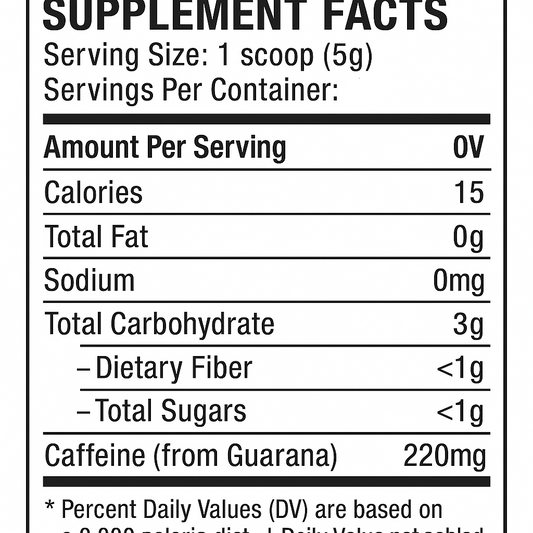
Natural caffeine comes from plants such as guarana, coffee, tea, and yerba mate rather than being synthesised. Mana Rush uses guarana extract, one of the most caffeine-dense natural plant sources, for about 200 mg of natural caffeine per 5g serving — zero sugar, zero synthetic stimulants.
How do I use Mana Rush guarana powder?
Mix one 5g scoop into cold water, sparkling water, or a smoothie — it dissolves in about 30 seconds. Use 250–300 ml of water for steady all-day energy or 60–80 ml for a concentrated, shot-strength dose. Start with one serving per day and adjust to taste and tolerance.
What flavors does Mana Rush come in?
Mana Rush is available in Mango, Lemon, Lime, Lilikoi (Passionfruit), Raspberry, and Lemongrass as core flavours, with limited edition and artisan blend flavours released seasonally. Mango is the most popular. Shop all flavours at manarushguarana.com.
Does Mana Rush have sugar?
No. Mana Rush Guarana contains zero added sugar and is sweetened only with stevia, a natural plant-based sweetener. It is also free from aspartame, sucralose, and other artificial sweeteners.
How much does Mana Rush cost per serving?
An 8oz bag of Mana Rush contains approximately 45 servings at under $1 per serving. Compared to canned energy drinks at $3–4 each, a daily Mana Rush habit costs roughly 60–75% less over a month.
Is Mana Rush made in Hawaii?
Yes. Mana Rush Guarana is blended and packaged in Kāneʻohe, Oahu, Hawaiʻi by Aloha Rush LLC. The guarana extract is sourced from Brazil and blended with natural tropical fruit powders in our Hawaiʻi facility.
Read next

Featured Mana Rush Guarana powders
Pick a flavor and add to cart directly below, or compare all options first.

Mana Rush Guarana Mango
Regular price
$40.00 USD
Regular price
Sale price
$40.00 USD
⭐ Bestseller · Clean guarana energy · ~45 servings per bag

Mana Rush Guarana Raspberry -Bright Berry Flavor. Clean Natural Energy
Regular price
$40.00 USD
Regular price
Sale price
$40.00 USD
Clean guarana energy · Steady energy · ~45 servings per bag

Mana Rush Guarana Lime – Natural Zesty Energy Boost
Regular price
$40.00 USD
Regular price
Sale price
$40.00 USD
Clean guarana energy · Steady energy · ~45 servings per bag