

Iceland on Lime — 3 Weeks, the Full Ring Road, and a Guarana That Kept Me Driving
Updated: 2026-06-28
Start here
New to Mana Rush? Start with the guide that fits your goal
If you are comparing coffee alternatives, natural energy powder, and smoother caffeine routines, these are the best next steps.
Mana Rush Guarana · Travel Journal · Iceland
Iceland on Lime
3 weeks. The full ring road. One camper van and a bag of guarana.
21Days
~2,500km driven
80%Dirt roads
1Flavor. Lime.
HNL → San Francisco → Reykjavík → Blue Lagoon → Ring Road → West Fjords → Vík → Jökulsárlón → East Fjords → Akureyri → Reykjavík → HNL
Iceland doesn't welcome you. It just opens the door and lets you walk in — and then the wind slams it shut behind you.
Three weeks in a camper van doing the full ring road solo. No tour group. No itinerary beyond "keep moving." Just me, the island, and a bag of Mana Rush Guarana Lime that earned its place in the glovebox on day one and never left it.
⚡ MRG Lime · Why Iceland needs it
Iceland is a wilderness-driving trip, not a city trip. You start each day at 100% and you drain — slowly, steadily, across long stretches of empty road where a flat tire isn't a small inconvenience, it's a situation. Staying sharp isn't optional. MRG Lime mixed into cold water every morning was how I kept the edge without the crash.
Reykjavík — Day One
14 hours from Honolulu. Straight to the Blue Lagoon.
We flew Alaska Airlines from Honolulu to San Francisco, then caught a non-stop overnight flight to Reykjavík. Fourteen hours of travel, landing slightly before lunch, jet-lagged and hungry — food on board was scarce enough that smoked salmon with dill from an airport kiosk felt like a proper meal.
Then, because Iceland is Iceland, we did what any rational person does two hours off a long-haul flight: drove straight to the Blue Lagoon. Sitting in a steaming, silky-blue geothermal pool in the middle of a lava field with a mud mask on your face and a drink in your hand is either the best decision you've ever made or a fever dream. Possibly both.

Blue Lagoon — two hours off the plane, already in the water
⚡ MRG Lime · The jetlag fix
Before picking up the camper van I mixed a scoop of MRG Lime into cold water at the rental agency. I had to drive the team from the moment we landed — long distances, unfamiliar roads, winter weather. Guarana's slow-release caffeine didn't spike me and dump me. It gave me clear, steady focus for the full first day. No jetlag. None. I was genuinely impressed.
That evening we wandered Reykjavík's harbor district — lobster soup at Sægreifinn, halibut skewers with skyr sauce, and a tasting of whale meat. Yes, people eat whale in Iceland. It's dark, lean, deeply savory — closer to beef than fish. Worth trying once, mostly for the conversation it starts back home.
We also stopped at the Museum of Sorcery and Witchcraft. Iceland has a long tradition of folk magic — stave symbols, necropants (look it up, then immediately wish you hadn't), and a catalog of spells that were taken very seriously by people living through brutal Arctic winters. Dark, strange, fascinating.
The Ring Road — Into the Wild
~2,500km. 80% dirt roads. Usually alone on them.
Route 1 — the Ring Road — circles the entire island. Most people drive sections of it on organized tours or stick to the well-photographed south coast. Doing the full loop in a camper, including the West Fjords and the geologically oldest section of the island in the east, is a different experience entirely. The roads get smaller, the landscape gets more extreme, and the people disappear.
About 80% of the roads I drove were gravel and dirt — unmarked, unpaved F-roads that the GPS treats as suggestions. On many stretches I was the only vehicle in any direction for as far as I could see. In that context, "staying alert" isn't a wellness tip. It's just survival. A flat tire on a dirt road in the Icelandic highlands, 40km from the nearest town, in deteriorating weather, is a very specific kind of problem you don't want to solve tired.

Typical road conditions — gravel, no markings, no other cars
⚡ MRG Lime · Sharp on the F-roads
Every morning before a long driving day: MRG Lime in 300ml of cold water, sipped over the first hour. On dirt roads you need spatial awareness, reaction time, and patience — not a caffeine spike that peaks and crashes halfway through. The slow release matched the pace of the drive. I covered big distances and arrived clear-headed every time.
The Waterfalls, the Rainbows, the Everything
Iceland is relentlessly, exhaustingly beautiful.
Iceland has more waterfalls than you can count or photograph or meaningfully describe. Skógafoss. Seljalandsfoss. Goðafoss. Dynjandi in the West Fjords — a cascading series of falls that spill down a cliff face like something from a fantasy novel. You stop for every one because you think each might be the best you've seen. They keep escalating.
Rainbows appear constantly — the light, the spray, and the perpetually dramatic sky conspire to put one in almost every waterfall photo you take. After the first few days you stop being surprised by them and start being annoyed when one isn't there.

A thousand rainbows — Iceland serves them daily
Along the way: seals lounging on river banks who couldn't care less about you. Horses — the small, incredibly sturdy Icelandic breed — appearing in fields with no fence and no apparent owner. White puff shapes on hillsides that turn out to be sheep. A Viking longhouse reconstruction that gives you a sense of what it meant to survive an Icelandic winter in the ninth century (answer: barely, and with a lot of communal body heat).
Vík — The Storm
The black sand beach that the Atlantic is actively trying to erase.
Vík is a small town on Iceland's south coast, sitting at the foot of a basalt cliff with a black sand beach that absorbs all light and reflects none of it back. The waves at Reynisfjara are among the most dangerous in the world — sneaker waves that have killed tourists who turned their backs to photograph the sea stacks.
We caught a storm in Vík. Not a polite drizzle — an actual Atlantic storm, the kind that shakes the camper van and makes sleeping feel like being inside a washing machine. Wind that doesn't push you, it repositions you. Cold that isn't just temperature but physical pressure against every exposed surface.
In the morning, when it cleared, the beach was even more dramatic than before. That's Iceland. It punishes you with the weather and then immediately pays you back with something you couldn't have seen without it.
⚡ MRG Lime · Post-storm morning
Sleep in a rocking van during a storm is not deep sleep. The morning after Vík I was running on adrenaline residue and not much else. MRG Lime in cold water before we moved on — the citrus cut through the fog, the guarana steadied the energy. We drove south toward the glacier lagoon and I didn't feel the night at all.
Jökulsárlón — The Iceberg Lagoon
A boat trip into a lagoon full of calving glaciers.
Jökulsárlón is a glacial lagoon on Iceland's southeast coast where icebergs calve from the Vatnajökull glacier and float slowly toward the sea. We took a boat out into it — a zodiac threading between ice formations the size of buildings, some glowing an impossible electric blue from within, others striped with dark ash layers from old volcanic eruptions.
The cold on that boat was a different category of cold. Wind off the ice. Spray from the water. The kind that gets into your joints and stays there. You wear every layer you have and still feel it in your teeth.
After the lagoon, the icebergs that don't make it to sea wash up on the black sand beach nearby — Diamond Beach — where they sit catching the low Arctic light before the tide takes them. No photograph does it justice. You have to stand there with the cold at your back and the ice in front of you and let it register in person.
West Fjords & the Oldest Rock
The part of Iceland that feels like the edge of the world.
The West Fjords are technically part of Iceland but feel like a different country. The roads get narrower. The towns get smaller. The fjords cut deep into the land and the light angles differently. This is also the geologically oldest section of the island — the rock here is significantly older than the volcanic activity that created the rest of Iceland, which is still actively forming in places you can watch in real time.
The West Fjords were the original destination — an expedition into Strandir, a remote region known locally for its association with folk magic, witchcraft, and the kind of landscape that inspired the world-building in Lord of the Rings and Game of Thrones. Both productions used Iceland as a backdrop for good reason: the terrain looks invented.
⚡ MRG Lime · Remote road awareness
In the West Fjords the roads narrow to single-lane gravel with passing points every few hundred metres. You drive slowly, you watch everything, and there is genuinely no margin for a bad decision. This is where constant, low-level alertness matters most — not sharp reflexes, just sustained presence. MRG Lime is exactly that kind of energy. No spike, no anxiety, just clear and awake for as long as the road requires.
Camping, Cold, and the Reality of the Van
Raw and natural. Just you and the island.
Three weeks in a camper van in Iceland is as honest a travel experience as you can have. You wake up where you parked the night before. Sometimes that's a campsite with showers and a kitchen. More often it's a pull-off on a gravel road with nothing around you in any direction except mountains and sky and the sound of wind.
The cold is ever-present. Not always dangerous, but always there. It infiltrates the van, it slows you down in the mornings, it makes simple tasks — cooking, changing clothes, dealing with gear — take twice as long. You adapt. You layer up. You learn to appreciate the hot spring pools that appear on the roadside with remarkable frequency, natural thermal water sitting in a stone-lined basin somewhere off an unmarked track, sometimes with a hand-painted sign, sometimes with nothing at all.
Those roadside pools are the great equalizer of Iceland road trips. You're cold, you're stiff, you pull over, you get in warm geothermal water under the sky, and everything resets. I stopped counting after the tenth one.
Camper food is functional but limited. At some point you start fantasizing about a proper sit-down meal. I tried to grill horse steaks on the van's small BBQ one evening — horse is a traditional protein in Iceland, lean and flavorful — but the wind had other plans. Sometimes Iceland reminds you who's in charge. That night we ate inside the van with the door barely cracked and called it a win.
⚡ MRG Lime · The drain is real
You start Iceland at 100%. The cold chips at you. Broken sleep in the van chips at you. Long driving days chip at you. By week two you feel it accumulating. MRG Lime extended that 100% further than it would have gone on its own — but eventually the body wants what it wants: warmth, a real bed, a hot meal that someone else cooked. Guarana can push the window. It can't replace the rest. Know the difference and you'll use it well.
☕ Iceland Travel Note — Coffee vs Guarana on the Road
The coffee drinkers took a nap. The guaranies drove.
On the first long driving day out of Reykjavík a debate broke out in the van: coffee vs guarana. The coffee drinkers argued their case with genuine intensity. After two bathroom stops (apparently coffee is very hydrating) the conversation wound down naturally, and not long after that the coffee half of the van took a nap while the guarana side navigated and kept us on route.
By day five, everyone in the van had switched to green guarana shots before we left each morning. The difference wasn't dramatic — it was just steady. No jitters on an empty stomach. No crash mid-afternoon on a long gravel stretch. Just consistent, manageable energy that matched what the driving actually required.
That's the case for guarana on a road trip: it's not about peak performance, it's about sustained performance. Coffee is great for a morning at a desk. For eight hours of wilderness driving with no services and no backup, you want something that lasts.
What three weeks in Iceland actually costs you
Iceland is not a comfortable trip. That's the whole point.
The cold is relentless. Not dangerous if you're prepared, but always there — in the mornings when you unzip the van, in the evenings when the wind picks up, on the boat to the icebergs, at every waterfall where the spray hits you. You adapt, but it takes something out of you every day.
Sleep in a camper van is functional, not restorative. You're comfortable enough but you're not recovering the way you would in a proper bed. After two weeks of gravel roads, cold mornings, and van cooking, you will want the Blue Lagoon, a restaurant meal, and a real hotel bed more than you have ever wanted anything.
🌡️ Cold. All the time. Even in summer, Iceland at altitude and on the coast is cold. In the van overnight it's colder. At the waterfalls it's wet and cold. Factor it into every plan. |
🛣️ Road concentration, all day. Gravel roads, single lanes, sheep on the tarmac, sudden weather. Driving Iceland requires consistent attention from the moment you start the engine to the moment you park. |
🍳 Van food gets old fast. You can cook in the van. You just can't cook well in the van, especially when the wind outside makes opening the door a structural challenge. |
🔋 You drain. Plan for it. Three weeks at this pace takes something from you. MRG extends the window. It doesn't eliminate the need for rest. Know the difference. |
"You start at 100% and Iceland drains you. Guarana extends the window. But eventually you will want the Blue Lagoon, a warm bed, and a meal someone else cooked — and that's exactly when Iceland becomes perfect."
Clarity that keeps you moving.
Iceland is not a trip you survive on autopilot. It demands attention from the first dirt road to the last hot spring. What you bring to fuel that attention matters.
Mana Rush Guarana Lime went into cold water every morning for three weeks across the full ring road. It kept me alert on empty gravel roads where alert was the only reasonable state to be in. No jitters. No crash. Just clean, steady energy that matched what the island actually asked of me.
The island and the guarana. Raw, natural, no nonsense. Both earned their place on that trip.
Mana Rush Guarana · Kāneʻohe, Hawaiʻi
Small-batch natural guarana energy powder.
Made for the days that ask the most of you.
Frequently asked questions
What is guarana?
Guarana (Paullinia cupana) is a climbing plant native to the Amazon basin whose seeds are one of the richest natural sources of caffeine. Used for centuries by Amazonian peoples for energy and focus, guarana delivers its caffeine more slowly than coffee due to natural plant compounds including tannins, saponins, theobromine, and theophylline.
Is guarana better than coffee for energy?
Many people find guarana energy smoother and more sustained than coffee because its caffeine releases gradually over 4–6 hours rather than hitting in a quick spike. The additional plant compounds in guarana — theobromine, tannins, polyphenols — modulate how caffeine is absorbed, producing a steadier lift with less of the heavy crash.
How long does guarana stay in your system?
Caffeine from guarana has a half-life of about 4–6 hours in most adults, with the slow-release profile meaning effects build gradually and taper off more gently than coffee. Metabolism, body weight, and caffeine sensitivity affect individual duration.
What is natural or plant-based caffeine?
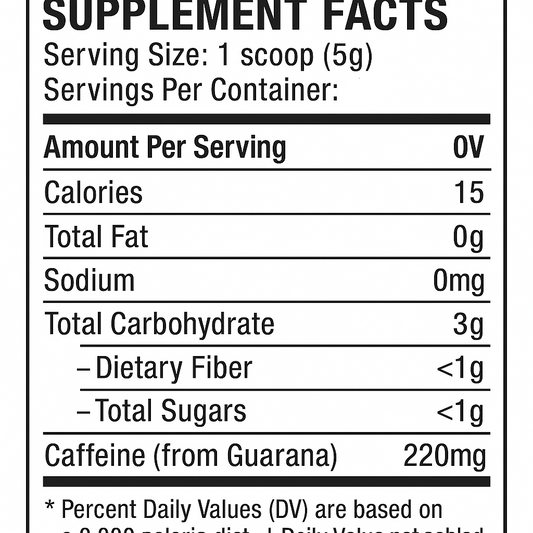
Natural caffeine comes from plants such as guarana, coffee, tea, and yerba mate rather than being synthesised. Mana Rush uses guarana extract, one of the most caffeine-dense natural plant sources, for about 200 mg of natural caffeine per 5g serving — zero sugar, zero synthetic stimulants.
How do I use Mana Rush guarana powder?
Mix one 5g scoop into cold water, sparkling water, or a smoothie — it dissolves in about 30 seconds. Use 250–300 ml of water for steady all-day energy or 60–80 ml for a concentrated, shot-strength dose. Start with one serving per day and adjust to taste and tolerance.
What flavors does Mana Rush come in?
Mana Rush is available in Mango, Lemon, Lime, Lilikoi (Passionfruit), Raspberry, and Lemongrass as core flavours, with limited edition and artisan blend flavours released seasonally. Mango is the most popular. Shop all flavours at manarushguarana.com.
Does Mana Rush have sugar?
No. Mana Rush Guarana contains zero added sugar and is sweetened only with stevia, a natural plant-based sweetener. It is also free from aspartame, sucralose, and other artificial sweeteners.
How much does Mana Rush cost per serving?
An 8oz bag of Mana Rush contains approximately 45 servings at under $1 per serving. Compared to canned energy drinks at $3–4 each, a daily Mana Rush habit costs roughly 60–75% less over a month.
Is Mana Rush made in Hawaii?
Yes. Mana Rush Guarana is blended and packaged in Kāneʻohe, Oahu, Hawaiʻi by Aloha Rush LLC. The guarana extract is sourced from Brazil and blended with natural tropical fruit powders in our Hawaiʻi facility.
Read next

Featured Mana Rush Guarana powders
Pick a flavor and add to cart directly below, or compare all options first.

Mana Rush Guarana Mango
Regular price
$40.00 USD
Regular price
Sale price
$40.00 USD
⭐ Bestseller · Clean guarana energy · ~45 servings per bag

Mana Rush Guarana Raspberry -Bright Berry Flavor. Clean Natural Energy
Regular price
$40.00 USD
Regular price
Sale price
$40.00 USD
Clean guarana energy · Steady energy · ~45 servings per bag

Mana Rush Guarana Lime – Natural Zesty Energy Boost
Regular price
$40.00 USD
Regular price
Sale price
$40.00 USD
Clean guarana energy · Steady energy · ~45 servings per bag