

16 Stunning Photos That Prove You Have No Clue How Food Is Grown
Updated: 2026-01-29
Start here
New to Mana Rush? Start with the guide that fits your goal
If you are comparing coffee alternatives, natural energy powder, and smoother caffeine routines, these are the best next steps.

Food Hacks
How Food Is Grown
We all enjoy eating delicious foods but most of us have absolutely no idea how that food grows or is produced. You’d probably be shocked with some of the truths behind how your favorite foods are made.
We’re about to throw back the curtain on some of them:
1) Pineapples
These come from crazy spikey looking bushes that grow out of the ground. The fruit comes from the middle of the plant.

2) Sesame Seeds
Sesame seeds come from sprouts plants that grow straight up and tall out of the ground inside of little pods known as “buds.” Source: Wikipedia
3) Artichokes
Artichokes come from big pretty purple flower with feathery tops. Source: Flickr/Miran Rijavec
4) Brussel Sprouts
Brussel sprouts are a member of the Germmifera group of cabbages and grow from a leafy green plant that is about 2.5 to 4 cm in diameter. They grow in a cluster and look like little cabbages. Source: Flickr
5) Capers
Capers grow on a vine of pretty white flowers. They are the unopened buds of the flowers.
6) Pistachios
Pistachios grow in clusters on trees. It usually takes seven to ten years for these trees to get significant production with peak production being reached around 20 years. The pistachios are then dried and dry roasted or processed in machines. They kind of look like mangoes.
7) Peanuts
Peanuts look like pretty little yellow wildflowers when they grow out of the ground but when you pull those flowers up their roots reveal the little bulbous nuts.
8) Vanilla Bean
Vanilla bean is also a flowering plant with white flowers. The plant produces long pods that are treated and dried.
9) Kiwi
Kiwis also start out as flowers that hangs on a vine and is grow along trellises. The flower turns into kiwis that hang down until they are ready to be harvested.
10) Cashews
Cashews are super weird looking. They grow on trees that produce cashew apples, then the nuts grow out of the apples.
11) Almonds
Almonds grow off of flowering trees. The little flowers turn into pods and inside those pods are almonds.
12) Saffron
Saffron comes from exquisitely beautiful bright purple flowers. The saffron stems come out of the middle of the flowers that are just pulled out of the flower.
13) Cinnamon
I had no idea that cinnamon is dried tree bark.
14) Cranberries
Cranberries grow off of evergreen dwarf shrubs that bear flowers that become the little pieces of fruit.
15) Cacao

Cacao, which is what chocolate is, is grown on a tree that produces giant pods. The cacao beans are found inside these pods.
16) Guarana

Recent studies from the U.S. National Library of Medicine have shown that guarana is unique in its ability to stimulate mental activity that is beneficial to long-term learning. Researchers compared the effects of guarana to other sources of caffeine such as coffee and ginseng; ultimately, the subjects who received moderate doses of guarana performed better than recipients of other caffeine derivatives. These findings imply that other components of the guarana compound are responsible for its advantageous cerebral influences. This indicates that caffeine is only part of the formula behind this supplement's success rate. Further studies must be conducted to discover why guarana continuously outpaces the competition when it comes to assistance in the academic realm.

Frequently asked questions
What is guarana?
Guarana is a plant native to the Amazon whose seeds are one of the richest natural sources of caffeine. It has been used for centuries as a natural energy source and is valued for delivering a smoother, slower-release lift than coffee.
Is guarana better than coffee for energy?
Many people find guarana energy feels smoother and steadier than coffee because its caffeine releases more gradually, with less of a spike and crash. Both contain caffeine, so it comes down to how your body responds.
How long does guarana stay in your system?
Caffeine from guarana has a half-life of about 4–6 hours in most adults, so the effect tapers off over the hours after a serving. Metabolism, body weight, and caffeine sensitivity all influence how long you feel it.
What is natural or plant-based caffeine?
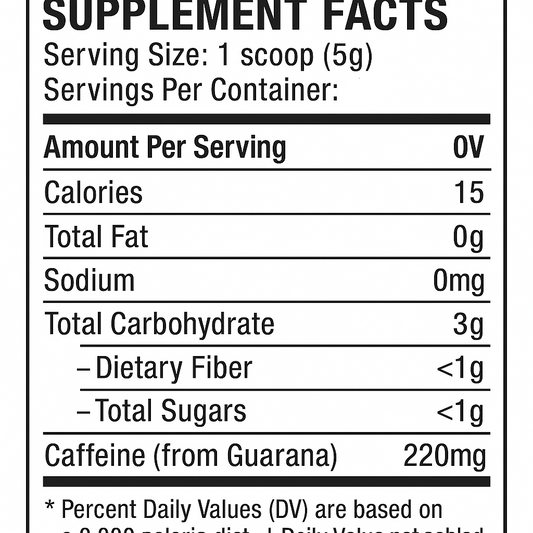
Natural caffeine comes from plants such as guarana, coffee, and tea rather than being made synthetically. Mana Rush uses guarana, one of the most caffeine-dense plants, for about 200 mg of natural caffeine per serving with zero sugar.
How do I use Mana Rush guarana powder?
Mix one scoop into cold water, sparkling water, or a smoothie — it dissolves in about 30 seconds. Use a full glass for steady energy or 60–80 ml for a concentrated shot. Start with one serving per day and adjust to taste and tolerance.
Read next
Featured Mana Rush Guarana powders
Pick a flavor and add to cart directly below, or compare all options first.

Mana Rush Guarana Mango
Regular price
$40.00 USD
Regular price
Sale price
$40.00 USD
⭐ Bestseller · Clean guarana energy · ~40 servings per bag

Mana Rush Guarana Raspberry -Bright Berry Flavor. Clean Natural Energy
Regular price
$40.00 USD
Regular price
Sale price
$40.00 USD
Clean guarana energy · No crash · ~40 servings per bag

Mana Rush Guarana Lime – Natural Zesty Energy Boost
Regular price
$40.00 USD
Regular price
Sale price
$40.00 USD
Clean guarana energy · No crash · ~40 servings per bag